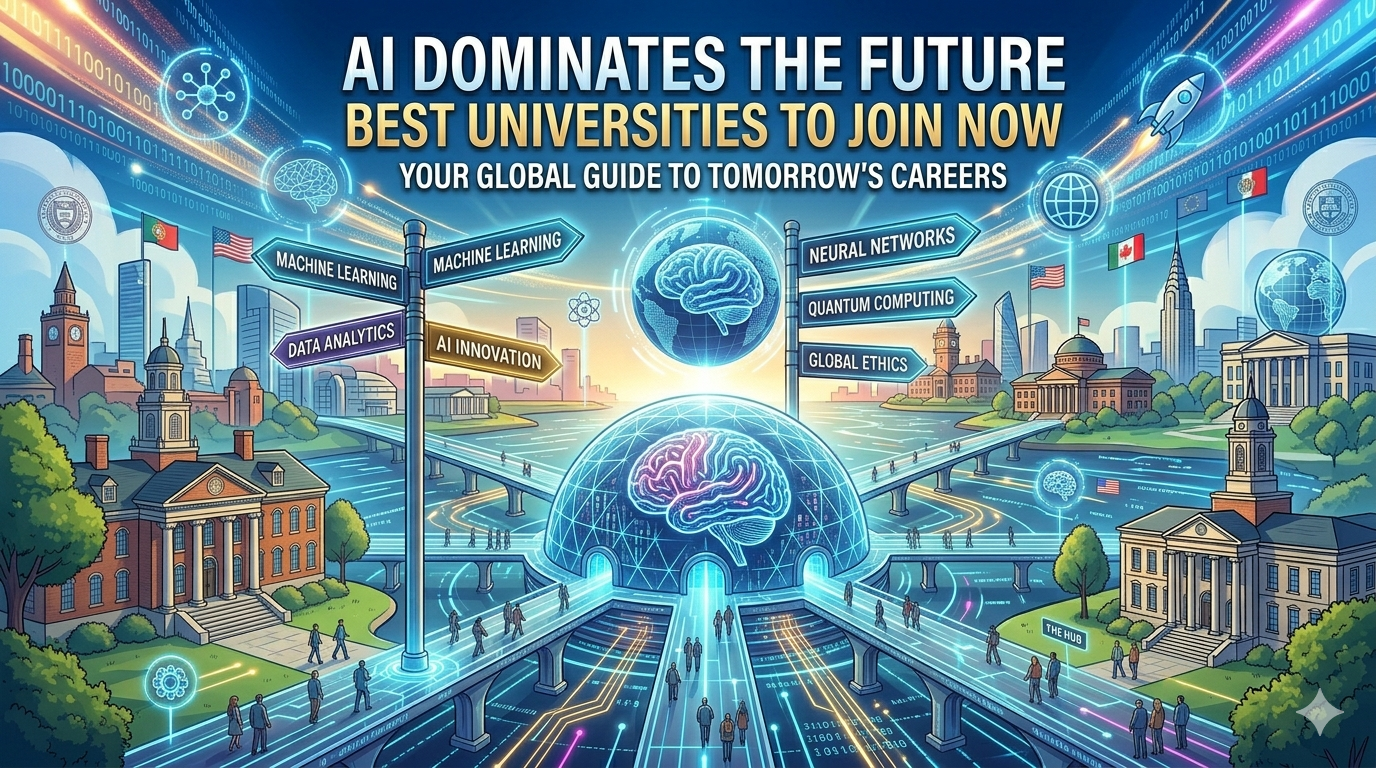
AI Dominates the Future: Best Universities to Join Now : Artificial Intelligence (AI) is rapidly becoming the backbone of modern technology. From voice assistants and automated factories to medical diagnosis systems and smart transportation networks, AI is changing how the world functions. As this powerful technology continues to expand, industries across the globe are looking for professionals who can develop, manage, and improve intelligent systems. For students planning their academic journey, selecting the right university is a critical step toward building a successful career in the AI-driven future.
The rise of AI has created a new era in education where universities are adapting their programs to train the next generation of engineers, researchers, and technology innovators. Choosing a university that focuses on artificial intelligence and emerging technologies can help students gain the knowledge and skills needed to succeed in the rapidly evolving digital economy.
The Growing Influence of Artificial Intelligence
Artificial Intelligence is no longer limited to research laboratories or large technology companies. Today, AI technologies are widely used in industries such as healthcare, finance, agriculture, transportation, education, and cybersecurity. Businesses rely on AI systems to analyze data, automate processes, detect patterns, and improve decision-making.
For example, AI algorithms help doctors detect diseases earlier, allow financial institutions to identify fraud, and enable online platforms to recommend personalized content to users. These applications demonstrate how AI is shaping modern industries and creating new career opportunities.
Because of this increasing demand, universities around the world are introducing specialized programs in artificial intelligence, machine learning, robotics, and data science. These programs are designed to equip students with the technical expertise required to work with intelligent technologies.
Why Choosing the Right University Matters
Selecting a university is one of the most important decisions students make in their academic journey. In the age of artificial intelligence, this decision becomes even more significant because the quality of education, research opportunities, and technological resources can directly influence career outcomes.
While many universities offer technology-related programs, not all provide the same level of training in AI. Some institutions focus primarily on theoretical learning, while others combine academic knowledge with practical applications and real-world projects.
Students should therefore carefully evaluate universities to ensure they choose an institution that prepares them for the future of technology.
Key Features of Universities Leading in AI Education
When searching for the best universities to join in the AI era, students should consider several important factors that contribute to a strong learning environment.
1. Comprehensive AI Curriculum
A strong university program should include courses covering essential AI technologies such as machine learning, deep learning, natural language processing, computer vision, robotics, and data analytics. These subjects form the foundation of artificial intelligence and help students understand how intelligent systems are built.
Universities that regularly update their curriculum to keep pace with technological advancements ensure that students learn the latest tools and techniques used in the industry.
2. Research Opportunities
Artificial intelligence is a field that evolves quickly through research and innovation. Universities with active research laboratories and innovation centers provide students with opportunities to participate in advanced projects.
Students involved in research may work on areas such as autonomous vehicles, healthcare AI systems, smart cities, and climate modeling technologies. These experiences help students develop deeper knowledge and critical thinking skills.
3. Industry Collaboration
Partnerships between universities and technology companies play an important role in preparing students for real-world careers. Universities that collaborate with leading tech firms often offer internship programs, industry workshops, and mentorship opportunities.
Internships allow students to gain hands-on experience working with AI technologies in professional environments. These experiences can significantly improve employment prospects after graduation.
4. Experienced Faculty
Faculty expertise is another key factor when evaluating universities. Professors who actively conduct AI research or have industry experience can provide valuable insights and mentorship.
Learning from experienced instructors helps students understand complex concepts and discover innovative ways to apply AI technologies in real-world situations.
5. Advanced Technological Infrastructure
Developing artificial intelligence systems requires powerful computing resources and access to large datasets. Universities that invest in high-performance computing facilities, AI laboratories, and modern software tools create better learning environments for students.
These resources allow students to experiment with machine learning models, develop intelligent applications, and explore innovative solutions.
The Importance of Practical Learning
In artificial intelligence education, practical experience is just as important as theoretical knowledge. Universities that emphasize project-based learning give students the opportunity to build real AI applications.
Students may work on projects such as developing chatbots, creating recommendation systems, building predictive analytics models, or designing robotics systems. These projects help students gain confidence and demonstrate their technical abilities.
Many universities also organize hackathons, innovation competitions, and technology workshops where students collaborate to solve real-world problems using AI.
Career Opportunities in the AI Era
Graduates with strong AI skills are highly valued in today’s job market. As AI technologies continue to expand, professionals with expertise in machine learning, data science, and intelligent systems will remain in high demand.
Some of the most common career paths in AI include:
- Artificial Intelligence Engineer
- Machine Learning Engineer
- Data Scientist
- Robotics Engineer
- AI Research Scientist
- Software Developer specializing in AI
These careers often provide excellent salary potential and the opportunity to work on groundbreaking technologies that shape the future.
Preparing for an AI-Focused Education
Students interested in pursuing AI education should begin by developing strong foundations in mathematics, programming, and analytical thinking. Programming languages such as Python are widely used in AI development and can be a valuable skill for aspiring students.
In addition to technical knowledge, creativity and curiosity are essential for success in artificial intelligence. The ability to explore new ideas and solve complex problems is what drives innovation in the field.
Conclusion
Artificial Intelligence is dominating the future of technology and transforming industries worldwide. Universities that focus on AI education are preparing students to become the innovators and leaders who will drive this technological revolution.
By choosing a university that offers strong AI programs, research opportunities, experienced faculty, and industry partnerships, students can gain the skills and knowledge needed to succeed in the digital age.
For students planning their academic future, joining the right university today can open the door to exciting opportunities in the world of artificial intelligence tomorrow. With dedication and the right education, they can become part of the generation shaping the intelligent technologies of the future. 🤖🎓🚀