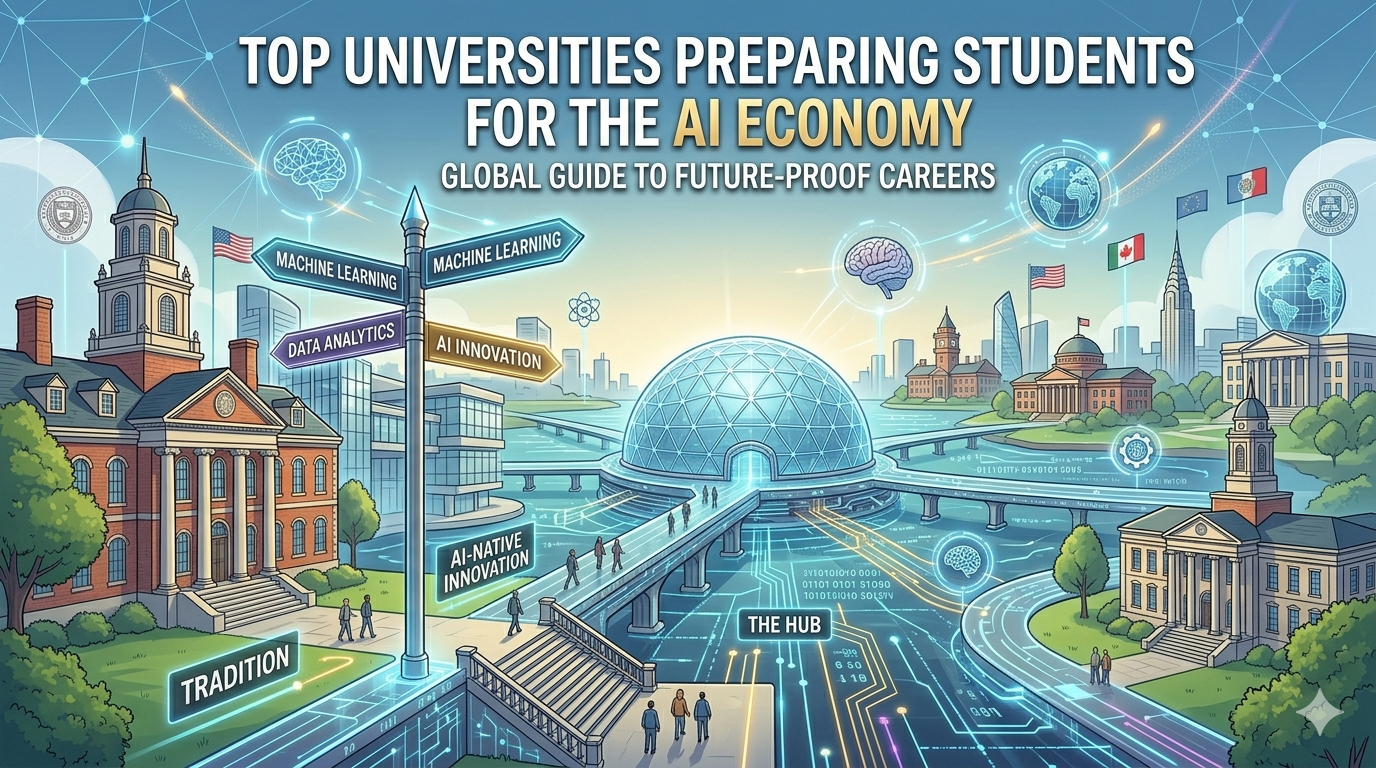
Artificial Intelligence (AI) is rapidly becoming one of the most influential technologies of the modern era. From smart assistants and recommendation systems to autonomous vehicles and advanced medical diagnostics, AI is reshaping industries and redefining the global economy. As companies increasingly rely on intelligent technologies to improve efficiency and innovation, the demand for skilled AI professionals continues to grow.
To meet this demand, universities around the world are developing specialized programs designed to train students for careers in artificial intelligence, machine learning, data science, and robotics. These institutions are not only teaching technical skills but also preparing students to navigate the economic and social impact of AI technologies. For students planning their future careers, choosing a university that focuses on AI education can be a crucial step toward success in the emerging AI economy.
Understanding the AI Economy
The AI economy refers to a global system where artificial intelligence plays a central role in productivity, innovation, and business development. Companies use AI to analyze large amounts of data, automate complex tasks, and make smarter decisions. Industries such as healthcare, finance, transportation, agriculture, cybersecurity, and entertainment are already experiencing significant transformation because of AI.
For example, AI-powered algorithms help doctors detect diseases earlier, assist financial institutions in identifying fraud, and enable businesses to deliver personalized customer experiences. These advancements create new job roles that require expertise in programming, data analysis, machine learning, and algorithm development.
As the AI economy expands, the need for well-trained professionals is growing rapidly. Universities that provide strong AI education are helping to prepare the next generation of innovators, engineers, and technology leaders.
How Universities Are Adapting to the AI Era
To keep pace with technological progress, many universities have redesigned their academic programs to include artificial intelligence and related fields. Instead of limiting AI education to advanced research programs, institutions are now offering undergraduate and postgraduate degrees focused specifically on AI, data science, and machine learning.
These programs combine computer science, mathematics, statistics, and engineering to help students understand both the theory and practical applications of AI technologies. Students learn how to build machine learning models, analyze complex datasets, design intelligent systems, and apply AI solutions to real-world challenges.
Universities are also incorporating interdisciplinary learning into AI programs. This approach allows students to explore how AI can be used in fields such as healthcare, environmental science, business management, and social sciences.
Key Features of Universities Leading AI Education
Not all universities offer the same level of preparation for the AI economy. The most effective institutions share several common characteristics that help students gain the skills needed for future careers.
1. Strong Academic Curriculum
Top universities offer comprehensive AI programs that cover essential subjects such as machine learning, deep learning, neural networks, natural language processing, robotics, and data analytics. These courses provide a strong technical foundation that allows students to understand how AI systems work and how they can be developed.
Universities that frequently update their curriculum to reflect technological advancements ensure that students stay relevant in a rapidly evolving field.
2. Research and Innovation Opportunities
Artificial intelligence is an area where research plays a critical role. Universities with active AI research centers allow students to work on innovative projects involving robotics, autonomous systems, healthcare technology, and smart cities.
Participating in research helps students develop advanced analytical skills and contribute to technological progress.
3. Collaboration with Industry
Partnerships between universities and technology companies are extremely valuable in preparing students for the AI economy. These collaborations often provide internship opportunities, industry mentorship, and access to real-world projects.
Through internships and collaborative programs, students gain practical experience working with professionals who are actively developing AI technologies.
4. Experienced Faculty
The expertise of faculty members is another important factor. Universities with professors who specialize in AI research or have industry experience provide students with valuable insights into emerging technologies.
Learning from experienced instructors helps students bridge the gap between theoretical knowledge and practical applications.
5. Advanced Technology Infrastructure
Developing artificial intelligence systems requires powerful computing resources and specialized software tools. Leading universities invest in high-performance computing systems, AI laboratories, and data research facilities that allow students to experiment with advanced technologies.
Access to these resources enables students to train machine learning models, build AI applications, and explore innovative solutions.
The Role of Practical Learning
In the AI economy, employers value practical experience as much as academic knowledge. Universities that emphasize project-based learning help students develop real-world problem-solving skills.
Students often work on projects such as developing chatbots, designing predictive analytics tools, creating recommendation systems, or building robotic applications. These experiences allow students to understand how AI technologies are implemented in real industries.
Hackathons, coding competitions, and AI innovation challenges also play an important role in helping students develop creativity and teamwork skills.
Career Opportunities in the AI Economy
Graduates who complete AI-focused university programs have access to a wide range of career opportunities. Some of the most popular roles include:
- Artificial Intelligence Engineer
- Machine Learning Engineer
- Data Scientist
- Robotics Engineer
- AI Research Scientist
- Software Developer specializing in AI
These careers offer strong growth potential and the opportunity to work on technologies that are shaping the future.
Preparing for the Future
Students interested in joining the AI economy should begin building strong foundations in mathematics, programming, and analytical thinking. Learning programming languages such as Python, understanding statistics, and practicing problem-solving skills can help prepare them for advanced AI studies.
Curiosity and creativity are also essential qualities for students who want to innovate and develop new AI solutions.
Conclusion
The rise of the AI economy is creating unprecedented opportunities for students who are prepared to embrace technological change. Universities that focus on artificial intelligence education are playing a critical role in training the professionals who will drive the next wave of innovation.
By offering strong academic programs, research opportunities, industry partnerships, and modern technological infrastructure, these institutions are helping students develop the skills needed for successful careers in the AI-driven world.
Choosing the right university is therefore an important step toward becoming part of the growing AI economy. With the right education and determination, students can help shape the technologies that will define the future of society and global industry. 🤖🎓🚀